

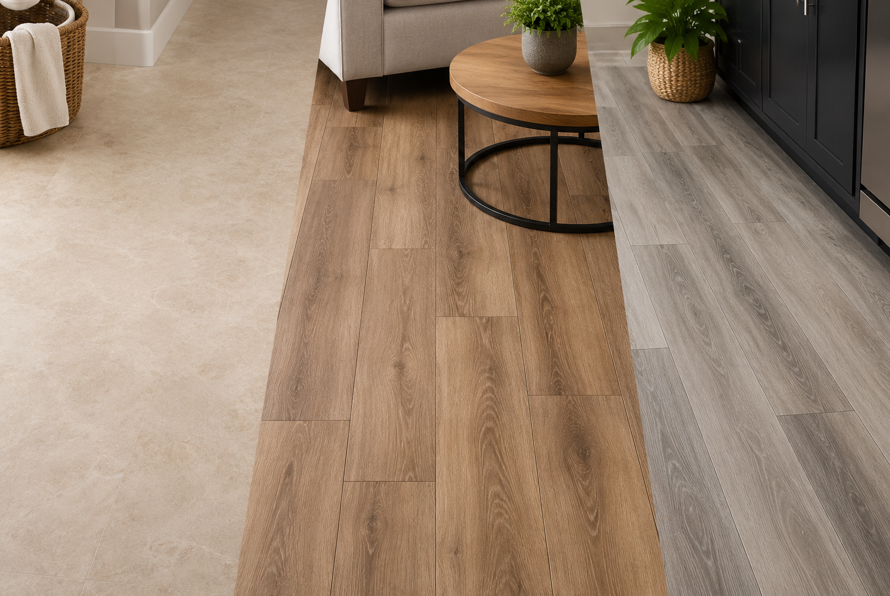
Why the Names Can Be Confusing
Walk into a flooring showroom or start researching online and you may quickly run into three similar terms: sheet vinyl, vinyl plank, and luxury vinyl. They all belong to the resilient flooring family, but they are not simply three interchangeable names for the same product.
For Ottawa, Ohio homeowners, understanding those terms can make the buying process much easier. The right choice depends on where the floor will be installed, the look you want, how the room is used, what kind of installation the space requires, and the level of performance you expect.
At Simplified Flooring, we help homeowners compare flooring by how it will actually perform in their homes, not just by what a label says. That matters with vinyl because product construction and installation format can differ considerably even when two floors have similar wood or stone visuals.
Here is the most important terminology point: “luxury vinyl” is a broad category. Luxury vinyl plank, usually shortened to LVP, is one type of luxury vinyl. Luxury vinyl tile, or LVT, is another. So when a store uses the phrase “vinyl plank,” it often means luxury vinyl plank rather than a completely separate flooring family.
Sheet vinyl is easier to distinguish. It comes in large rolls rather than individual planks or tiles. Mannington notes that residential sheet vinyl commonly comes in rolls 6 to 12 feet wide, which can reduce the number of seams in a finished room.
That difference in format affects appearance, installation, repairs, seams, and the way each floor works in different rooms.
This guide breaks down those differences in plain language so you can decide which vinyl format makes the most sense for your kitchen, bathroom, laundry room, basement, entryway, or other living space.
Sheet Vinyl: A Continuous Surface With Fewer Seams
Sheet vinyl is the traditional roll-format version of vinyl flooring. Rather than installing individual boards or tiles, an installer works with a large sheet that is cut to fit the room.
That format gives sheet vinyl one of its biggest practical advantages: fewer seams.
Why Fewer Seams Can Matter
In kitchens, bathrooms, laundry rooms, and similar spaces, fewer seams can be useful because there are fewer joints between pieces of flooring. Mannington notes that sheet vinyl can often be installed without seams in smaller high-moisture rooms, depending on room dimensions and product width.
Larger or irregular rooms may still need seams, and installation details vary by product and layout.
Design Options Have Come a Long Way
Sheet vinyl is not limited to the simple patterns some homeowners may remember from older homes.
Modern products can reproduce:
Wood visuals
Stone looks
Slate-inspired designs
Tile patterns
Decorative motifs
Neutral or bold contemporary patterns
Manufacturers now offer sheet designs with much more detailed printing and texture than earlier generations. Mannington, for example, currently offers sheet products in wood, stone, slate, and patterned visuals.
Best Fit for Sheet Vinyl
Sheet vinyl may be worth considering if:
You want fewer seams across the room.
You prefer a continuous surface.
The room has regular moisture or spill exposure.
You like stone, tile, or patterned visuals without individual tile joints.
You want a resilient floor that feels comfortable underfoot.
The subfloor and room layout are suitable for the selected installation method.
One tradeoff is that damage to a small area can be less straightforward to address than replacing one individual plank. Repair options depend on the product, location of the damage, and installation.
Vinyl Plank: A Wood-Look Format Built Around Individual Boards
Vinyl plank flooring is designed in individual plank-shaped pieces, usually to create the look of hardwood.
This format is one reason vinyl plank has become such a familiar choice in living rooms, kitchens, hallways, bedrooms, and open-plan spaces. Individual boards create visible plank lines, variation, and layout options that help the floor resemble a wood installation.
Shaw describes luxury vinyl plank as vinyl flooring designed to reproduce wood planks in details such as color, species, and surface texture.
The Important Catch: Vinyl Plank Is Usually Luxury Vinyl Plank
This is where shopping terminology gets messy.
Many products sold simply as “vinyl plank” are actually LVP, which stands for luxury vinyl plank. In other words, vinyl plank is often a format within the broader luxury vinyl category rather than a separate category that competes with luxury vinyl.
When comparing products, look beyond the headline name and ask about the actual construction.
You may encounter:
Glue-down vinyl planks
Click-lock planks
Flexible luxury vinyl
Rigid-core luxury vinyl
Products with attached underlayment
Products that require a separate underlayment or specific subfloor preparation
Karndean, for example, distinguishes gluedown luxury vinyl, which is adhered to the subfloor, from rigid-core flooring installed as a floating floor without adhesive.
Why Homeowners Like the Plank Format
The plank format works especially well when the goal is a wood-inspired appearance.
It can:
Create a familiar hardwood-style layout.
Offer many wood colors and grain patterns.
Work across several connected rooms for visual continuity.
Allow individual pieces to create more realistic variation.
Provide layout flexibility depending on product and installation method.
For an Ottawa home where you want the warmth of a wood look but prefer a resilient-flooring construction, plank-format vinyl is often one of the first categories worth exploring.
Luxury Vinyl: The Broader Category With Plank and Tile Formats
“Luxury vinyl” describes a class of resilient flooring rather than one single shape.
The category usually includes luxury vinyl plank, which mimics wood, and luxury vinyl tile, which is commonly designed to reproduce stone, ceramic, or other tile looks. Shaw describes LVP as the wood-plank format and LVT as the tile or stone-inspired format.
That distinction matters because homeowners sometimes hear “vinyl plank” and “luxury vinyl” presented as if they are completely different materials. Often, the plank they are considering is already a luxury vinyl product.
Why Luxury Vinyl Gets So Much Attention
Luxury vinyl can offer detailed visuals, textured surfaces, multiple construction types, and different installation systems.
Depending on the product, you may find glue-down or click-lock installation, flexible or rigid-core construction, different wear-layer specifications, and different warranties.
That is why it is better to compare actual products than to assume every luxury vinyl floor performs the same way. If you are browsing vinyl flooring, compare construction, approved rooms, maintenance, installation method, and warranty details as well as color and pattern.
Sheet Vinyl vs Vinyl Plank: The Biggest Day-to-Day Differences
Once the terminology is clear, the comparison becomes easier.
Appearance
Sheet vinyl presents the design across a continuous roll. It can imitate wood, tile, or stone, but the surface remains one connected sheet or several larger sections when seams are required.
Vinyl plank uses separate pieces. If you want a convincing hardwood-style layout with individual board lines and variation from plank to plank, the plank format usually makes more visual sense.
Seams
Sheet vinyl can provide very few seams and, in some rooms, potentially none.
Plank flooring naturally contains joints between individual pieces because the floor is built one plank at a time.
That does not automatically make one better. It simply changes how the floor is constructed and how the finished surface behaves.
Repairs
With plank flooring, a localized problem may sometimes be addressed at the plank level, although the exact repair process depends on whether the floor is glued down or floating and where the affected piece is located.
With sheet flooring, localized repairs can be more noticeable or require a different approach because the material is installed in larger continuous sections.
Always ask what repair options are realistic for the particular product before installation.
Subfloor Preparation
Both formats rely on proper subfloor preparation.
A smooth, stable subfloor is especially important because irregularities can affect how resilient flooring looks and performs. The installation instructions for the specific product determine what preparation is required.
Do not choose between sheet and plank based on an assumption that one automatically eliminates preparation work.
Which Vinyl Format Works Best Room by Room?
There is no single winner for every room. The best choice depends on what happens in that space every day.
Kitchens
Kitchens see spills, food debris, chair movement, and steady foot traffic.
Sheet vinyl can appeal to homeowners who value a continuous surface with minimal seams. Luxury vinyl plank can be attractive when the kitchen connects directly to a living or dining area and you want one wood-look floor to continue throughout.
Before selecting either, verify that the specific product is approved for the kitchen and review its cleaning and maintenance guidance.
Bathrooms and Laundry Rooms
These rooms make moisture performance an important consideration.
Sheet vinyl has the advantage of potentially minimizing seams, particularly in smaller rooms. Luxury vinyl products can also be designed for moisture-prone areas, but installation requirements and product specifications matter.
Do not rely on the word “vinyl” alone. Confirm the manufacturer's water-resistance or waterproof claims, installation details, perimeter requirements, and approved applications for the exact product.
Living Rooms and Open Floor Plans
Luxury vinyl plank is especially appealing in larger living spaces because the individual boards create a natural wood-style rhythm across the floor.
It can also provide visual continuity between a living room, hallway, dining space, and kitchen.
Sheet vinyl may still be an option, particularly where practicality or a particular design is the priority, but many homeowners prefer plank-format visuals in these prominent spaces.
Basements
Basements can have different subfloor and moisture considerations from upper levels.
Before selecting any vinyl product for a basement, identify the subfloor, check for moisture concerns, and verify that the exact flooring and installation system are approved for below-grade use.
A rigid-core luxury vinyl product may be appropriate in some basement applications, while other products may call for different preparation or installation. Product specifications, not category names, should guide the decision.
Entryways and Mudroom-Style Areas
Ottawa homes can bring in wet shoes, grit, and seasonal debris at entrances.
For these locations, compare durability, cleaning requirements, texture, moisture performance, and how easily the floor connects to adjacent rooms.
A patterned sheet floor can make a practical design statement, while plank flooring can continue the same wood-look aesthetic used elsewhere in the home.
How Installation Method Can Change the Decision
Two floors that look almost identical on a sample board may install very differently.
Glue-Down Flooring
Glue-down vinyl is adhered directly to a prepared subfloor.
This method is available in both sheet products and certain luxury vinyl planks or tiles. The exact adhesive, preparation, acclimation, and installation process comes from the product manufacturer.
Glue-down plank and tile formats can also offer design flexibility because individual pieces can be arranged according to the approved layout.
Floating Click-Lock Flooring
Many rigid-core luxury vinyl planks use a locking system and float over the subfloor instead of being glued directly to it.
Karndean describes rigid core as a floating installation where adhesive is not required.
Floating floors still require careful preparation, expansion spacing where specified, and attention to manufacturer instructions. “Floating” does not mean the subfloor can be ignored.
Room Shape and Transitions
The size and shape of the room also influence installation.
Large open spaces, cabinets, islands, doorways, transitions, and adjoining flooring can all affect which product and installation method make the most sense.
This is one area where professional measuring and product-specific guidance can help prevent a good-looking sample from becoming the wrong installation choice.
Compare More Than the Price Tag
Cost matters, but it should not be the only comparison.
Two vinyl products can have different constructions, warranties, installation needs, and performance. A lower material price may not represent the complete installed cost, just as a higher-priced product is not automatically the best fit.
When comparing options, ask about:
Material price
Subfloor preparation
Installation method
Transitions and trim
Removal of existing flooring
Manufacturer warranty
Approved rooms
Cleaning requirements
Repair considerations
Expected traffic in the room
This gives you a more useful picture of long-term value.
Which Choice Is Right for Your Ottawa, OH Home?
Choose sheet vinyl when a continuous surface, fewer seams, and flexible pattern choices are high priorities.
Consider vinyl plank when you want the look and layout of individual wood boards.
Explore luxury vinyl when you want to compare higher-detail plank and tile formats, including options with different constructions and installation systems.
Remember that these categories overlap. A vinyl plank you love may already be luxury vinyl plank. Compare the specific product construction with the other vinyl options that fit your room.
Before deciding, view samples in the actual space if available, alongside cabinets, trim, countertops, or nearby flooring.
Then ask practical questions:
Is this product approved for the room?
How will it be installed?
What preparation does the subfloor need?
How does it handle the level of moisture expected here?
What maintenance does the manufacturer recommend?
Does the pattern work at full-room scale?
How will it transition into neighboring floors?
What does the warranty actually cover?
The answers will tell you far more than the product name alone.
Find a Vinyl Floor That Fits the Way You Live
Sheet vinyl, vinyl plank, and luxury vinyl can all be smart choices, but they solve slightly different design and installation needs.
Sheet vinyl stands out for its roll format and ability to reduce seams. Plank-format vinyl creates the individual-board appearance many homeowners want when they are drawn to wood visuals. Luxury vinyl is the broader category that includes many plank and tile products, with a variety of constructions and installation methods.
For Ottawa homeowners, the best option is the one that fits the room, the subfloor, the household, and the look you want to live with every day.
Do not get caught up in labels. Compare the actual product, including its construction, installation requirements, moisture guidance, maintenance, warranty, and approved uses alongside color, texture, and style.
If you would like help comparing vinyl options for your Ottawa-area home, get in touch with Simplified Flooring. Our team can help you sort through the terminology, compare practical features, and find a beautiful floor that suits your space and everyday needs.


