

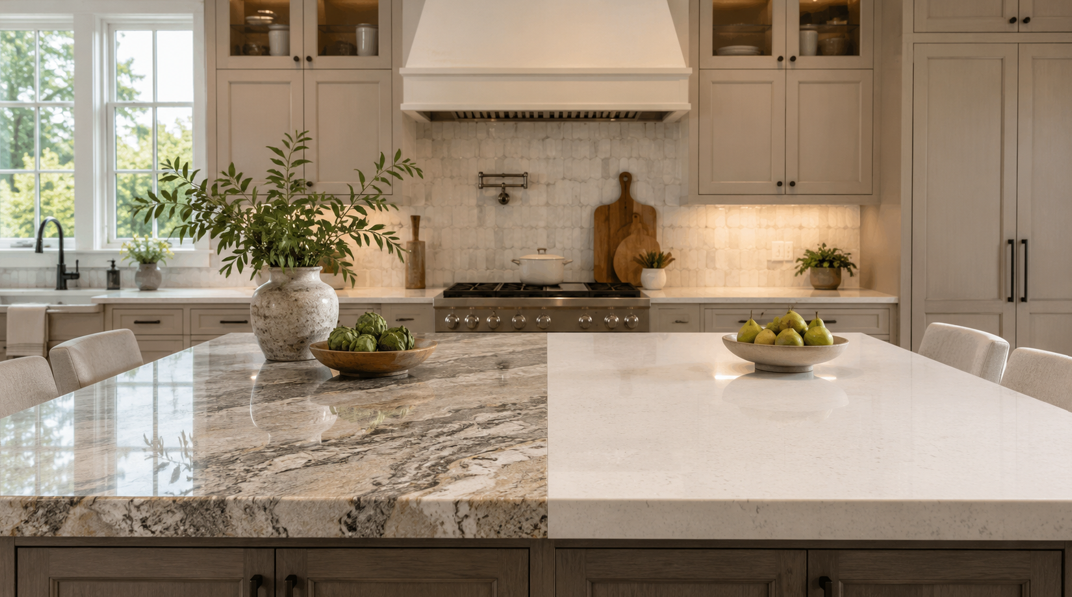
Understanding the Difference Before You Choose
A countertop influences how your kitchen looks, how it handles daily use, and how much care it needs over time. It is also one of the most visible surfaces in the room, so the material you select can shape the entire design.
For homeowners in Delphos, two popular categories often rise to the top: natural stone and engineered stone. Both can create a beautiful, durable countertop, but they are made differently and offer distinct advantages.
Natural stone is quarried from the earth and cut into slabs. Granite, marble, quartzite, soapstone, and certain other materials fall into this category. Every slab develops through natural geological processes, so its color, veining, mineral deposits, and movement are unique.
Engineered stone is manufactured by combining crushed minerals with resins, pigments, and other binding materials. Quartz countertops are the most familiar example. Manufacturers control the color and pattern, which creates greater consistency from one slab to another.
Neither option is automatically better for every home. The right choice depends on your cooking habits, design preferences, maintenance expectations, budget, and the way your household uses the kitchen.
Homeowners working with Simplified Flooring can compare countertop materials alongside cabinetry, flooring, backsplashes, and other kitchen finishes. Looking at the full design together helps prevent one surface from feeling disconnected from the rest of the room.
Before choosing between natural and engineered stone, it helps to understand how they compare in appearance, durability, maintenance, heat resistance, stain resistance, cost, and long-term value.
What Is a Natural Stone Countertop?
Natural stone countertops begin as large blocks removed from quarries. The stone is cut into slabs, finished, and fabricated to fit the kitchen.
Because the material forms naturally, no two slabs are exactly alike. Even slabs from the same quarry can differ in pattern, shade, mineral content, and veining.
Popular Types of Natural Stone
Several natural stones are used for countertops, although their performance and care requirements vary.
Granite
Granite is known for its durability, heat resistance, and wide range of colors. Depending on the slab, it may include subtle speckling, sweeping movement, or dramatic mineral patterns.
It works well in busy kitchens because it can handle regular use when properly installed and maintained. Most granite benefits from periodic sealing to reduce moisture and stain absorption.
Marble
Marble offers elegant veining and a soft, classic appearance. White and gray varieties are especially popular, but marble is available in many colors.
It is softer and more porous than granite or quartzite. Acidic foods such as lemon juice, vinegar, and tomatoes can leave dull marks called etching. Some homeowners appreciate the patina that develops over time, while others prefer a surface that keeps a more uniform finish.
Quartzite
Quartzite is a natural stone formed from sandstone under intense heat and pressure. It often features flowing patterns that resemble marble while offering greater hardness.
It should not be confused with engineered quartz. Quartzite is quarried from the earth, while quartz countertops are manufactured from mineral particles and resin.
Soapstone
Soapstone has a smooth, matte feel and usually appears in shades of gray, charcoal, or green. It does not require traditional sealing, but many homeowners apply mineral oil to deepen its color and help the surface develop an even patina.
It is resistant to acids and heat, although it can scratch more readily than harder stones.
Why Homeowners Choose Natural Stone
The main appeal of natural stone is authenticity. Each slab has characteristics that cannot be duplicated exactly.
Homeowners may choose it because they want:
One-of-a-kind veining or mineral movement
A material formed naturally rather than manufactured
Strong heat resistance
A high-end, substantial appearance
A countertop that develops character over time
A direct connection to natural colors and textures
Natural stone can feel especially appropriate in kitchens with wood cabinetry, natural flooring, metal hardware, and other organic materials.
What Is an Engineered Stone Countertop?
Engineered stone is manufactured using crushed quartz or other minerals combined with pigments and resin. The mixture is formed into slabs under controlled conditions.
The best-known engineered stone countertop is commonly called quartz.
How Engineered Stone Is Designed
Because engineered stone is manufactured, its appearance can be controlled more precisely than natural stone.
Manufacturers can create:
Solid colors
Fine speckled patterns
Marble-inspired veining
Concrete-style finishes
Soft neutral surfaces
Bold, dramatic movement
Consistent color across multiple slabs
This level of control gives homeowners more predictability. A sample generally provides a clearer indication of what the installed countertop will look like, although some variation can still occur.
Why Homeowners Choose Engineered Stone
Engineered stone appeals to people who want a polished appearance with straightforward everyday care.
Common benefits include:
A nonporous surface
No routine sealing
Consistent color and pattern
Strong stain resistance
A broad selection of styles
Easier matching across larger installations
A smooth, uniform finish
It is often selected for family kitchens, busy households, and designs that depend on precise color coordination.
Appearance and Design Variety
Appearance is one of the biggest differences between natural and engineered stone.
The Character of Natural Stone
Natural stone offers variations created by mineral deposits, pressure, heat, and other geological processes. A slab may contain veins, color shifts, crystalline areas, or small natural markings.
These details give the countertop depth and individuality. They can also make selection more involved because the exact slab matters.
A small sample may not show the full pattern. For that reason, homeowners selecting natural stone often benefit from viewing the complete slab before fabrication.
Natural stone works particularly well when the countertop is intended to become the room’s main focal point. A dramatic granite or quartzite slab can serve almost like a piece of artwork.
The Consistency of Engineered Stone
Engineered stone provides a more controlled look. This can be helpful when the kitchen includes a long countertop run, a large island, or multiple surfaces that need to coordinate closely.
Homeowners who prefer symmetry, soft patterns, or clean modern design may appreciate this consistency.
Engineered stone can also imitate marble-style veining without offering the same care requirements as marble. The appearance is manufactured rather than naturally formed, but high-quality patterns can still look refined and convincing.
Which Looks Better?
Beauty is subjective, so the better choice depends on what you want from the design.
Choose natural stone when you prefer:
Genuine variation
Organic movement
Unique slabs
A countertop with strong visual character
Natural imperfections and mineral details
Choose engineered stone when you prefer:
Predictable coloring
Controlled patterns
Easier material matching
Clean and uniform surfaces
A particular shade that may be hard to find in nature
The countertop should also be considered alongside the other major surfaces in the room. If the flooring and backsplash already contain strong patterns, a quieter countertop may create better balance.
Durability in a Busy Kitchen
Both natural and engineered stone can perform well in a residential kitchen, but durability involves more than hardness alone.
Scratch Resistance
Granite and quartzite are hard materials that resist many everyday scratches. Engineered quartz is also highly scratch resistant.
That does not make any countertop completely scratch-proof. Cutting directly on the surface can damage the finish and dull kitchen knives. A cutting board remains the best option for food preparation.
Marble and soapstone are softer. They may scratch or mark more easily, although some surface marks can blend into the patina or be professionally addressed.
Chipping and Impact
Stone countertops are strong, but edges and corners can chip if struck by a heavy object.
The edge profile affects vulnerability. A sharply squared edge may show damage more readily than a rounded or softened profile.
Natural stone can contain internal fissures or mineral variations, while engineered stone has a more uniform internal structure. However, both materials require proper handling, fabrication, support, and installation.
Performance Around Seams
Large kitchens may require more than one slab. Seam location and visibility depend on:
Slab dimensions
Countertop layout
Pattern movement
Cabinet support
Sink and cooktop placement
Fabrication planning
Engineered stone patterns may be easier to match in some installations because they are more consistent. Dramatic natural stone requires careful planning so veining flows as smoothly as possible across adjoining pieces.
Stain Resistance and Everyday Cleaning
Countertops come into contact with coffee, cooking oils, sauces, wine, juice, spices, and many other substances. How quickly you clean spills still matters, regardless of the material.
Natural Stone Maintenance
Many natural stones are porous to some degree. Sealing helps reduce the rate at which liquids can enter the surface.
Granite typically requires periodic sealing, although the exact schedule varies according to the stone and sealer. Some dense granites absorb very little, while lighter or more porous varieties may need more attention.
Marble is vulnerable to both staining and etching. Sealer can help with absorption, but it does not prevent acidic substances from reacting with the surface.
Quartzite often needs sealing as well. Soapstone does not require a conventional sealer, but mineral oil may be applied for appearance.
For routine cleaning, homeowners can generally use a soft cloth, warm water, and a cleaner recommended for the specific stone.
Engineered Stone Maintenance
Engineered quartz is nonporous and does not need routine sealing. This makes daily maintenance relatively simple.
Most spills can be cleaned with mild soap, water, and a soft cloth. Its low absorption also helps resist staining from many common kitchen substances.
However, strongly colored spills should still be cleaned promptly. Certain chemicals, abrasive cleaners, and harsh scrubbing pads may damage the resin or finish.
The Practical Difference
Engineered stone usually offers the simpler maintenance routine. Natural stone requires greater awareness of sealing, cleaner compatibility, and the material’s specific sensitivities.
That does not mean natural stone is impractical. Many households use it successfully for decades. The key is choosing a stone whose care requirements fit your habits.
Heat Resistance
Heat performance is another important difference.
Natural Stone and Heat
Granite, quartzite, soapstone, and many other natural stones tolerate heat well. Their natural formation under high temperatures contributes to their performance.
Even so, placing a hot pan directly on any countertop is not recommended. Thermal shock, finish damage, hidden weaknesses, or temperature differences around seams may create problems.
Using trivets protects both the material and the surrounding sealants or adhesives.
Engineered Stone and Heat
Engineered quartz contains resin, which can react to high temperatures. Direct contact with hot cookware may discolor the surface or damage the resin.
A trivet, heat pad, or other protective barrier is especially important with engineered stone.
Households that regularly move hot cookware from the oven or stovetop may value the greater natural heat tolerance of granite, quartzite, or soapstone. However, safe countertop habits still matter with every material.
Comparing Natural Stone and Engineered Stone Costs
Countertop pricing depends on much more than whether the material is natural or engineered.
Factors may include:
Material type
Color and pattern
Slab availability
Grade or rarity
Countertop dimensions
Edge profile
Number of cutouts
Sink style
Backsplash details
Fabrication requirements
Seam placement
Installation conditions
Natural Stone Price Factors
Common granite may fall within a more accessible price range, while rare granite, marble, or quartzite can cost considerably more.
Slab yield also matters. A kitchen with a large island or complex layout may require an additional slab, even when only part of that slab is needed.
Natural patterns can affect fabrication because the team may need to align veins or avoid certain natural features.
Engineered Stone Price Factors
Engineered quartz is available across several price levels. Manufacturer, color, pattern complexity, slab thickness, and design collection can all affect the cost.
Simple patterns may be more value-focused, while elaborate marble-inspired designs can sit at the premium end of the range.
Look Beyond the Initial Price
The lowest starting price does not always represent the best long-term value.
Consider:
Expected maintenance
Sealing needs
Repair possibilities
Design longevity
Household use
Installation quality
How long you plan to remain in the home
A material that fits your habits is more likely to provide lasting satisfaction than one chosen only because of its initial cost.
Exploring Natural Stone for Delphos Homes
A well-selected natural stone countertop can add depth, permanence, and individuality to a kitchen. It may be especially appealing in Delphos homes where homeowners want to preserve traditional character while updating function and style.
The broader natural stone flooring category also demonstrates how organic materials can bring variation, texture, and timeless appeal into a home. When countertops and flooring are planned together, they do not need to match exactly. They can connect through shared undertones, related colors, or a similar sense of natural movement.
For example:
Warm granite may coordinate with oak-look flooring and cream cabinetry.
Gray quartzite may pair with cool wood tones, white cabinets, and brushed nickel hardware.
Dark soapstone can create contrast with pale flooring and simple cabinetry.
Marble may work with quiet flooring that allows its veining to remain the focal point.
The aim is coordination, not duplication.
Sustainability and Material Origins
Homeowners increasingly ask how products are made and where materials come from.
Natural Stone Considerations
Natural stone is a long-lasting material with no plastic resin content. It can remain in service for decades when cared for properly.
However, quarrying, cutting, processing, and transporting heavy slabs require energy. A stone sourced from a distant location may travel a considerable distance before installation.
Natural stone can sometimes be refinished, repaired, or reused, depending on its condition and the new application.
Engineered Stone Considerations
Engineered stone uses mineral content that may include crushed stone byproducts. This can make productive use of material that might otherwise be discarded.
The manufacturing process also uses resins and energy. Environmental characteristics vary by manufacturer, product composition, plant practices, and transportation distance.
Rather than assuming one category is always more sustainable, homeowners can ask practical questions about durability, expected lifespan, manufacturer information, local availability, and maintenance.
A countertop that remains attractive and functional for many years can reduce the need for early replacement.
Coordinating Countertops With Cabinets, Backsplashes, and Flooring
A countertop is not a standalone design decision. Its color and pattern affect every nearby surface.
Start With the Strongest Pattern
Identify which material will carry the most visual movement.
If you choose a dramatic natural stone slab, consider simpler cabinets, flooring, and backsplash materials. If you select a quiet engineered countertop, you may have more flexibility to use patterned tile or strongly grained flooring.
Compare Undertones
Set samples beside one another and look for warm, cool, or neutral undertones.
A white countertop might lean cream, gray, blue, or even pink. Those subtle differences become more obvious next to cabinetry and flooring.
Consider Cabinet Color
White cabinets work with both natural and engineered stone, but the countertop’s undertone affects whether the combination feels warm or crisp.
Wood cabinets often pair well with natural stone because both materials contain organic variation. Engineered stone can create an effective contrast by introducing a cleaner, more uniform surface.
Dark cabinets may benefit from lighter countertops, while pale cabinets can support either light continuity or strong contrast.
Balance the Backsplash
A backsplash sits directly against the countertop and can either strengthen or soften its pattern.
With dramatic stone, consider a simple tile in a secondary countertop color. With subtle engineered stone, a textured glass tile, mosaic, or patterned layout can add visual interest.
Review Everything Under Kitchen Lighting
Samples can look different under showroom lights, daylight, and warm indoor bulbs.
Compare the countertop with cabinets, flooring, backsplash, paint, and hardware in the actual room whenever possible. View the materials in the morning and evening before making the final decision.
Which Material Fits Different Household Priorities?
The right countertop often becomes clearer when you focus on daily routines.
Choose Natural Stone If You Value Individuality
Natural stone may be the better fit when you want:
A one-of-a-kind slab
Genuine mineral variation
Strong heat resistance
A natural focal point
A material that develops character
The opportunity to select the exact slab
You may also be comfortable with periodic sealing and material-specific care.
Choose Engineered Stone If You Value Consistency
Engineered stone may be the better fit when you want:
Predictable color and pattern
A nonporous surface
No routine sealing
Strong stain resistance
Easier matching across several surfaces
Straightforward daily maintenance
It can also suit homeowners who want a particular marble-inspired appearance with fewer maintenance considerations than natural marble.
For Families With Children
Engineered quartz may appeal to busy families because it is nonporous and easy to clean. Granite can also work well when properly sealed and maintained.
The best choice depends on whether the household prioritizes lower maintenance, heat tolerance, pattern consistency, or natural character.
For Frequent Home Cooks
Cooks who regularly use hot pans may appreciate the heat resistance of granite, quartzite, or soapstone. Trivets are still recommended.
Home cooks who value stain resistance and quick cleanup may prefer engineered quartz.
For Design-Focused Renovations
Natural stone can create an unmatched focal point when the exact slab is selected carefully.
Engineered stone may work better when the design requires consistent veining, precise color matching, or several coordinated countertop sections.
Questions to Ask Before Making a Decision
Before choosing a countertop, consider the following questions:
Do I prefer natural variation or a consistent pattern?
Am I comfortable with periodic sealing?
How often do I cook with acidic ingredients?
Do I frequently place hot cookware near the countertop?
Will the countertop be the room’s focal point?
Does the kitchen require more than one slab?
How important is stain resistance?
Do I want to choose the exact slab?
Which material coordinates best with my cabinetry and flooring?
How much everyday wear does the kitchen receive?
Am I comfortable with a surface that develops patina?
Which option fits the total project budget?
Answering these questions can narrow the options before you begin comparing individual colors and patterns.
Making the Best Choice for Your Delphos Kitchen
Natural stone and engineered stone can both create beautiful, long-lasting countertops.
Natural stone stands out for its genuine variation, geological character, and strong heat resistance. Granite, marble, quartzite, and soapstone each offer a different balance of appearance and performance.
Engineered stone stands out for its consistent design, nonporous surface, stain resistance, and simple maintenance. It offers many colors and patterns, including styles inspired by natural marble and other stone.
The better countertop is the one that fits your household rather than the one that appears most impressive in isolation.
Choose natural stone when unique movement, authenticity, and natural character matter most. Choose engineered stone when predictability, low maintenance, and color consistency are higher priorities.
Whichever material you prefer, compare full-size samples or slabs alongside your cabinets, flooring, backsplash, hardware, and lighting. Thoughtful coordination can make the entire kitchen feel intentional and complete.
Ready to compare countertop materials for your Delphos home? Reach out to us for personalized guidance on creating a kitchen that fits your style, routines, and long-term plans.


