

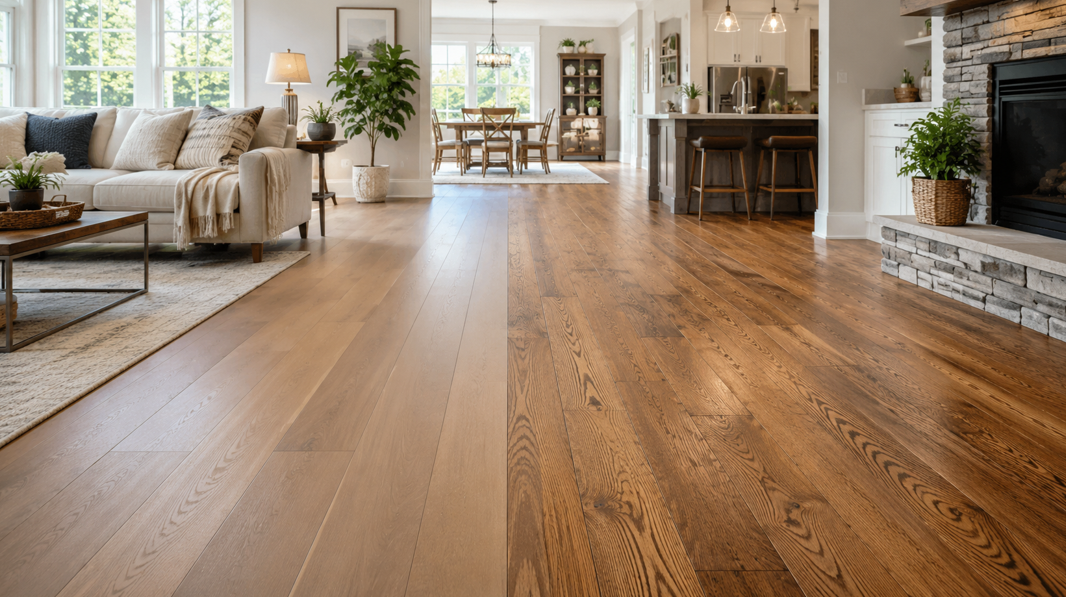
Choosing Hardwood Flooring for the Way Your Home Lives
Hardwood flooring can bring warmth, character, and lasting style to almost any room. It works with traditional interiors, modern renovations, farmhouse-inspired spaces, and everything in between. Yet once homeowners begin shopping, an important question quickly appears: should you choose engineered hardwood or solid hardwood?
Both products use genuine wood and can create a beautiful finished floor. The difference lies mainly in how they are constructed and how that construction affects installation, moisture response, refinishing, stability, and long-term performance.
Solid hardwood is milled from one continuous piece of timber. Engineered hardwood uses a real hardwood surface layer bonded to multiple supporting layers underneath. From the top, the two floors can look remarkably similar, particularly when they use the same species, stain, plank width, and finish.
The better option depends on more than appearance. Wapakoneta homeowners also need to consider seasonal humidity, subfloor type, room location, household activity, maintenance preferences, and future renovation plans.
At Simplified Flooring, homeowners can compare hardwood samples alongside cabinetry, countertops, paint colors, and adjoining floors. Viewing the materials together makes it easier to choose a floor that feels coordinated throughout the home.
This guide compares engineered and solid hardwood across the factors that matter most, helping you select a floor that fits both your style and your everyday routine.
What Is Solid Hardwood Flooring?
Solid hardwood flooring is made from a single piece of wood from top to bottom. Each plank is cut, shaped, sanded, and finished to create a consistent flooring product.
Common species include:
Oak
Maple
Hickory
Walnut
Cherry
Birch
The species affects the floor’s color, grain, hardness, and overall character.
How Solid Hardwood Is Made
A solid hardwood plank typically includes a tongue on one edge and a groove on the other. These interlocking edges help align the boards during installation.
The flooring may be purchased prefinished or unfinished.
Prefinished boards arrive with stain and protective coatings already applied. This allows the floor to be installed with less finishing work inside the home.
Unfinished boards are installed first and then sanded, stained, and sealed on site. This method can create a highly uniform surface because the entire floor is finished after installation.
Why Homeowners Choose Solid Hardwood
Solid hardwood has a long history in residential design. Homeowners often select it because they value:
Traditional construction
Natural wood character
The ability to refinish the surface
Long-term design flexibility
A substantial feel underfoot
The possibility of matching existing hardwood
A floor that can develop a natural patina
A well-maintained solid hardwood floor can remain part of a home through several design updates. Its stain color may be changed during refinishing, allowing the floor to support a new interior style without being fully replaced.
What Is Engineered Hardwood Flooring?
Engineered hardwood is constructed from several bonded layers.
The top surface, often called the wear layer or veneer, is genuine hardwood. Beneath it are supporting layers made from plywood, hardwood, or other wood-based materials. These layers are arranged to improve dimensional stability.
The visible surface can feature the same wood species, grain patterns, stains, and finishes used on solid hardwood.
How Engineered Hardwood Is Constructed
The supporting layers are typically positioned in alternating directions. This cross-layered construction helps reduce the amount of expansion and contraction caused by environmental changes.
The thickness of the hardwood wear layer varies by product. Some engineered floors have a thin surface layer, while others contain enough genuine hardwood to allow professional sanding and refinishing.
The total plank thickness, core material, locking system, finish, and wear layer all influence performance.
Why Homeowners Choose Engineered Hardwood
Engineered hardwood is often selected because it offers:
Genuine hardwood appearance
Greater dimensional stability
More installation options
Compatibility with certain concrete subfloors
Suitability for some below-grade spaces
Wider plank possibilities
Reduced movement during humidity changes
A range of price and construction levels
It is not a wood-look substitute. The top layer is real wood, so the grain, color variation, and texture remain authentic.
How the Two Floors Compare in Appearance
Engineered and solid hardwood can look almost identical after installation.
If both products use the same species, stain, finish, texture, and plank width, most people will not be able to identify the construction simply by looking at the floor from above.
Wood Species and Grain
Both formats are available in popular species such as oak, maple, hickory, and walnut.
Oak offers recognizable grain and broad design flexibility. Maple generally has a smoother, more subtle pattern. Hickory features stronger color variation and character. Walnut creates a deeper, richer appearance.
The natural grain matters more visually than the material beneath the surface.
Plank Width
Engineered construction often supports wider planks because the layered core helps control movement.
Wide-plank flooring can make a room feel open and highlight the grain of the wood. It may suit large living areas, open floor plans, and modern designs.
Solid hardwood is also available in wide planks, but wider boards may react more noticeably to humidity changes. The installation environment and product specifications become especially important.
Color Variation
Natural wood contains variation between boards. Some products are graded for a more consistent appearance, while others include knots, mineral streaks, and stronger color changes.
Neither engineered nor solid hardwood is automatically more uniform. Variation depends on the species, grade, cut, stain, and manufacturing process.
Surface Texture
Both flooring types may feature:
Smooth finishes
Wire-brushed textures
Hand-scraped effects
Matte coatings
Low-gloss finishes
Beveled edges
Natural oil finishes
Texture can affect both style and practicality. A lightly textured surface may help disguise small scratches, pet marks, and everyday wear better than a very smooth, glossy floor.
Stability During Ohio’s Seasonal Changes
Wapakoneta experiences warm, humid summers and cold, dry winters. Indoor humidity can change significantly as air conditioning and heating systems operate throughout the year.
Wood naturally responds to these changes.
How Solid Hardwood Responds
Solid wood absorbs and releases moisture from the surrounding air. As moisture levels rise, the boards may expand. As conditions become drier, they may contract.
Small seasonal gaps can appear between planks during winter. In more humid conditions, the gaps may narrow again.
Excessive moisture can contribute to cupping, where plank edges rise higher than the centers. Very dry conditions can lead to shrinkage, gaps, or surface checking.
This does not mean solid hardwood is unsuitable for Ohio homes. It means indoor conditions, acclimation, subfloor preparation, and installation methods need careful attention.
How Engineered Hardwood Responds
Engineered hardwood also contains real wood and still responds to environmental conditions. However, its layered construction generally limits movement across the width of the plank.
This added stability can make engineered hardwood appealing for:
Wide-plank installations
Homes with seasonal humidity swings
Certain basement applications
Concrete subfloors
Open spaces with long flooring runs
Rooms where environmental control may vary
Engineered flooring is not waterproof, and it still requires suitable humidity and moisture conditions. Its construction simply makes it less reactive than many solid hardwood products.
Managing Indoor Humidity
Whichever product you select, stable indoor conditions support better performance.
Helpful habits include:
Using air conditioning during humid weather
Running a dehumidifier when needed
Avoiding extreme winter dryness
Addressing plumbing leaks promptly
Using kitchen and bathroom ventilation
Following the flooring manufacturer’s humidity guidance
Checking moisture levels before installation
The goal is not to maintain one exact number every day. It is to avoid severe or prolonged swings that place unnecessary pressure on the wood.
Installation Options and Subfloor Requirements
The existing subfloor can strongly influence which hardwood product is suitable.
Installing Solid Hardwood
Traditional solid hardwood is commonly nailed or stapled to a suitable wood subfloor.
This installation method works well over plywood or approved wood-based subflooring. It is less commonly used directly over concrete because fasteners require an appropriate surface.
Solid hardwood may also raise the finished floor height, which can affect doors, transitions, appliances, and adjoining rooms.
Installing Engineered Hardwood
Engineered hardwood generally offers more installation flexibility.
Depending on the specific product, it may be:
Nailed
Stapled
Glued
Floated
Installed over concrete
Used over approved radiant heating systems
Installed on more than one level of the home
A floating floor connects the planks to one another without fastening every board directly to the subfloor. Glue-down installation bonds the flooring to the prepared surface. Nail-down installation may be used over suitable wood subfloors.
Not every engineered product supports every installation method. The selected flooring’s instructions determine the approved approach.
Concrete Subfloors
Concrete can hold and transmit moisture, even when it appears dry.
Before installation, the slab may need moisture testing, surface preparation, patching, leveling, or an approved moisture-control system.
Engineered hardwood is often the more practical hardwood option over concrete because certain products are designed for glue-down or floating installation.
Uneven Subfloors
Both solid and engineered hardwood perform best over a flat, stable, clean surface.
An uneven subfloor can lead to:
Movement
Gaps
Squeaks
Hollow areas
Stress on locking joints
Visible height differences
Premature wear
Subfloor assessment is an important part of the project, not an optional detail.
Performance in Basements and Below-Grade Rooms
Room location matters when comparing hardwood products.
Solid Hardwood Below Grade
Solid hardwood is generally not recommended for below-grade installation because basements may experience higher moisture levels and vapor movement through concrete.
Even finished basements that appear dry can behave differently from rooms above ground.
Engineered Hardwood Below Grade
Certain engineered hardwood products are approved for below-grade settings when moisture conditions, subfloor preparation, and installation requirements are met.
Its layered construction provides better dimensional stability, making it the more common real-wood option for a finished basement.
That does not mean every basement is ready for hardwood. Before installation, homeowners need to address:
Active leaks
Foundation moisture
Plumbing concerns
Musty odors
Previous flooding
High humidity
Concrete moisture
Drainage problems
Flooring cannot correct an underlying moisture issue.
When Another Material May Be Better
In a basement with ongoing moisture concerns, another flooring category may offer a more practical solution.
The best choice is based on the room’s actual conditions rather than the appearance homeowners hope to achieve.
Refinishing and Long-Term Flexibility
Refinishing is one of the most important differences between individual hardwood products.
Refinishing Solid Hardwood
Solid hardwood can usually be sanded and refinished multiple times because the plank is made from the same material throughout.
The number of possible refinishing cycles depends on plank thickness, previous sanding, damage, and the position of the tongue-and-groove joint.
Refinishing can:
Remove many surface scratches
Refresh a worn finish
Change the stain color
Reduce visible discoloration
Update the floor for a new interior style
Deep damage, severe movement, or pet stains that penetrate far into the wood may not disappear completely.
Refinishing Engineered Hardwood
Some engineered hardwood can be refinished, while other products cannot.
The determining factor is the thickness of the genuine hardwood wear layer. A thicker layer may allow professional sanding, while a very thin veneer may support only light screening or recoating.
Before purchasing, ask:
How thick is the wear layer?
Can the product be sanded?
How many refinishing cycles are expected?
Can the finish be screened and recoated?
What maintenance products are approved?
Do not assume all engineered floors have the same refinishing potential.
Recoating Instead of Full Sanding
A floor does not always need to be sanded down to bare wood.
When the finish is worn but the wood remains in good condition, professional screening and recoating may restore protection and appearance with less material removal.
Routine care and timely recoating can extend the period between full refinishing projects.
Scratch, Dent, and Wear Resistance
Hardwood is durable, but no wood floor is completely resistant to scratches or dents.
Species Hardness
Wood species differ in hardness. Hickory and certain maple products generally resist denting better than softer woods, while walnut may mark more readily.
Hardness is only one part of performance. Finish quality, texture, color, grain, and household habits also affect how visible wear becomes.
Finish Protection
Factory-applied finishes can provide strong resistance to everyday abrasion. Site-finished floors also offer durable protection when the correct coating system is applied.
A finish protects the surface, but it does not turn wood into an impact-proof material.
Pets
Pet claws can leave marks, particularly on smooth, dark, or high-gloss floors.
Pet-friendly choices may include:
Matte finishes
Wire-brushed textures
Mid-tone colors
Visible grain
Character-grade boards
Harder wood species
Keeping nails trimmed and placing rugs near entrances can reduce visible wear.
Furniture
Furniture legs can scratch or dent hardwood when pieces are dragged.
Use clean felt pads under chairs, tables, sofas, and movable furniture. Check them regularly because grit can become embedded in the pad.
Rolling office chairs may require a suitable floor protector.
Everyday Grit
Sand and grit act like abrasives under shoes and furniture.
Entry mats, regular sweeping, and prompt cleaning help protect both engineered and solid hardwood. These simple habits often matter more than the difference between the two constructions.
Moisture, Spills, and Cleaning
Neither engineered nor solid hardwood is waterproof.
Handling Spills
Wipe up spills promptly with a soft, absorbent cloth. Pay attention to board edges and seams, where liquid may enter the flooring system.
Avoid leaving wet towels, pet bowls, plant pots, or damp footwear directly on the floor.
Routine Cleaning
A practical maintenance routine includes:
Sweeping or vacuuming loose debris
Using a hardwood-safe vacuum setting
Cleaning with a manufacturer-approved product
Applying cleaner to the mop rather than flooding the floor
Using a lightly damp cleaning pad
Drying any remaining moisture promptly
Steam cleaners and excessive water can damage wood flooring and may affect the finish or warranty.
Kitchens and Dining Areas
Hardwood can work well in kitchens and dining spaces when spills are handled quickly and household routines support proper care.
Rugs or mats may be useful near:
Exterior doors
Sinks
Dishwashers
Food preparation zones
Pet feeding areas
Choose breathable rug pads approved for hardwood finishes.
Comfort, Sound, and Feel Underfoot
Both flooring types provide the warmth and natural character associated with real wood, but installation can affect how each one feels.
Solid Hardwood Feel
Nail-down solid hardwood usually feels firm and substantial underfoot. Its direct connection to a wood subfloor can create the traditional sound many homeowners associate with hardwood flooring.
Engineered Hardwood Feel
Nail-down or glue-down engineered hardwood may feel similarly solid.
Floating engineered floors can sound and feel slightly different because they are not fastened directly across the entire subfloor. The underlayment, plank thickness, locking system, and room acoustics affect the result.
A quality underlayment may help with:
Sound reduction
Minor subfloor separation
Comfort
Moisture management
Installation requirements
Only use underlayment approved for the selected flooring and installation method.
Upper-Level Rooms
Hardwood can transmit footsteps and impact noise to rooms below.
Area rugs, runners, furniture, underlayment, and installation choices may help reduce sound. In bedrooms or upstairs hallways, acoustic comfort may deserve as much attention as appearance.
Comparing Cost and Long-Term Value
The price of hardwood flooring depends on more than whether it is engineered or solid.
Important cost factors include:
Wood species
Plank width
Grade
Finish
Wear-layer thickness
Core construction
Installation method
Subfloor preparation
Room shape
Removal of existing flooring
Transitions
Stairs
Trim work
Moisture control
Solid Hardwood Cost Considerations
Solid hardwood may involve additional installation or finishing costs, particularly when unfinished boards are sanded and sealed on site.
Its refinishing potential may support long-term value for homeowners who expect to keep the flooring for many years.
Engineered Hardwood Cost Considerations
Engineered hardwood is available across a wide range of quality and price levels.
A basic product with a thin veneer is very different from a premium product with a thick wear layer, strong core, wide plank, and detailed finish.
Some installations may become more practical with engineered flooring because it can work over concrete or use alternative installation methods.
Value Is About Product Fit
A floor offers better value when it is suited to the room and the household.
A less costly solid hardwood installation may not provide good value if the room has moisture conditions that make it unsuitable. A premium engineered floor may not be necessary in a low-use bedroom over a traditional wood subfloor.
Evaluate the complete project rather than comparing material prices alone.
Coordinating Hardwood With the Rest of the Home
Hardwood flooring often connects several rooms, making coordination especially important.
Homeowners exploring hardwood flooring can compare species, plank widths, colors, and textures to find a product that works with both current and planned design features.
Cabinets and Wood Tones
Wood flooring does not need to match wood cabinetry exactly.
A slight contrast often looks more natural than an almost-match. For example:
Dark cabinets may pair with medium or light flooring.
Light oak cabinets can work with deeper brown floors.
Painted cabinets provide flexibility for many wood tones.
Warm cabinets generally pair best with floors that share compatible undertones.
Avoid placing two heavily grained woods together without a quieter surface to balance them.
Countertops
Countertops can help connect the cabinet and floor colors.
A countertop containing both warm and cool tones may provide flexibility. A strong pattern may pair best with a quieter hardwood grain, while a simple countertop can support more character in the floor.
Backsplashes
The backsplash offers another opportunity to repeat a floor undertone or create contrast.
A warm white, taupe, green, blue, or gray backsplash can connect the flooring with the upper half of the kitchen without matching it directly.
Adjoining Floors
Consider how hardwood will transition to:
Carpet
Tile
Luxury vinyl
Laminate
Existing wood
Entry flooring
Bathroom flooring
Differences in color, plank direction, material height, and transition pieces affect the finished appearance.
Natural and Artificial Light
Wood colors change under different lighting.
A sample may look warmer in afternoon sunlight, darker under cabinets, and cooler beneath certain LED bulbs. View samples in the actual room at several times of day.
Which Option Works Best in Different Rooms?
The ideal choice may vary throughout the home.
Living Rooms and Family Rooms
Both solid and engineered hardwood can work well.
Solid hardwood may suit a traditional above-grade room over a wood subfloor. Engineered hardwood may be preferable for wide planks, large open areas, or installations where added stability is valuable.
Bedrooms
Either product can create a warm, comfortable bedroom.
The decision may depend on subfloor type, budget, plank preference, and whether refinishing flexibility matters.
Kitchens
Both may be suitable when spills are cleaned promptly and the installation meets product requirements.
Engineered hardwood’s dimensional stability may appeal in an open kitchen that connects to a large living space.
Dining Rooms
Both products offer an attractive foundation for dining furniture.
Felt pads, careful chair movement, and prompt spill cleanup help preserve the finish.
Basements
Engineered hardwood is generally the more suitable real-wood choice when the product is approved for below-grade use and moisture conditions are controlled.
Solid hardwood is generally not recommended below grade.
Entryways and Mudrooms
Hardwood near an exterior entrance requires thoughtful maintenance.
Water, snow, salt, and grit can affect the surface. Durable mats and frequent cleaning are important. In a heavily exposed mudroom, another flooring material may be more practical.
Home Offices
Both products can work in a home office. Consider rolling chairs, heavy furniture, sound, and the likelihood that equipment layouts may change.
Choose Solid Hardwood When These Priorities Matter
Solid hardwood may be the stronger fit when:
The room is above grade.
The home has a suitable wood subfloor.
Multiple future refinishing cycles are important.
You prefer traditional flooring construction.
Matching existing solid hardwood is a priority.
You want site-finished flooring.
Seasonal movement is acceptable.
The indoor environment is consistently managed.
Long-term stain-color flexibility matters.
It can be especially appropriate in established homes where maintaining a traditional material is part of the renovation goal.
Choose Engineered Hardwood When These Priorities Matter
Engineered hardwood may be the stronger fit when:
The floor will be installed over concrete.
The room is below grade and approved conditions are met.
Wide planks are part of the design.
Added dimensional stability is important.
The project requires glue-down or floating installation.
The flooring may be used over approved radiant heat.
The room experiences moderate seasonal humidity changes.
A specific prefinished appearance is preferred.
Installation flexibility matters.
A premium engineered floor can offer substantial real-wood character while supporting applications that may not suit solid hardwood.
Questions to Ask Before Making Your Decision
Before choosing a product, ask:
Is the room above or below grade?
Is the subfloor wood or concrete?
Has the space experienced moisture problems?
How stable is the home’s indoor humidity?
Do I want narrow, standard, or wide planks?
How important is future refinishing?
How thick is the engineered wear layer?
Which installation methods are approved?
Will the floor be installed over radiant heat?
Are pets or children likely to create visible wear?
What finish and texture will best disguise daily marks?
How will the flooring meet adjoining rooms?
Does the floor coordinate with the cabinets and countertops?
What subfloor preparation is required?
What cleaning products does the manufacturer recommend?
How long do I expect to keep the floor?
What does the complete installed project cost?
These questions help move the decision beyond appearance and toward long-term suitability.
Finding the Right Hardwood for Your Wapakoneta Home
Engineered hardwood and solid hardwood both provide genuine wood beauty. The difference is not that one is real and the other is imitation. Both use natural hardwood on the visible surface.
Solid hardwood offers traditional construction, strong refinishing potential, and long-term design flexibility. It is often a natural fit for above-grade rooms with suitable wood subfloors.
Engineered hardwood offers greater dimensional stability and more installation options. It may be better suited to concrete, selected below-grade rooms, wide planks, and homes where seasonal humidity movement is a concern.
The right choice depends on the room, subfloor, moisture conditions, household routines, and flooring specifications. A carefully selected engineered product can outperform an unsuitable solid floor, while solid hardwood may provide exceptional long-term value in the right environment.
Compare full-size samples in your home, review the product construction, and consider how the floor will connect with nearby surfaces. The best hardwood floor is one that looks beautiful while fitting the practical conditions of the space.
Ready to compare engineered and solid hardwood options for your Wapakoneta residence? Reach out to us for personalized guidance from the Simplified Flooring team.


